100% independent laboratory
CapsuLabs is an independent laboratory with no stake in the result. That is why insurers, lawyers, managing agents and employers use our reports as the starting point every party accepts.
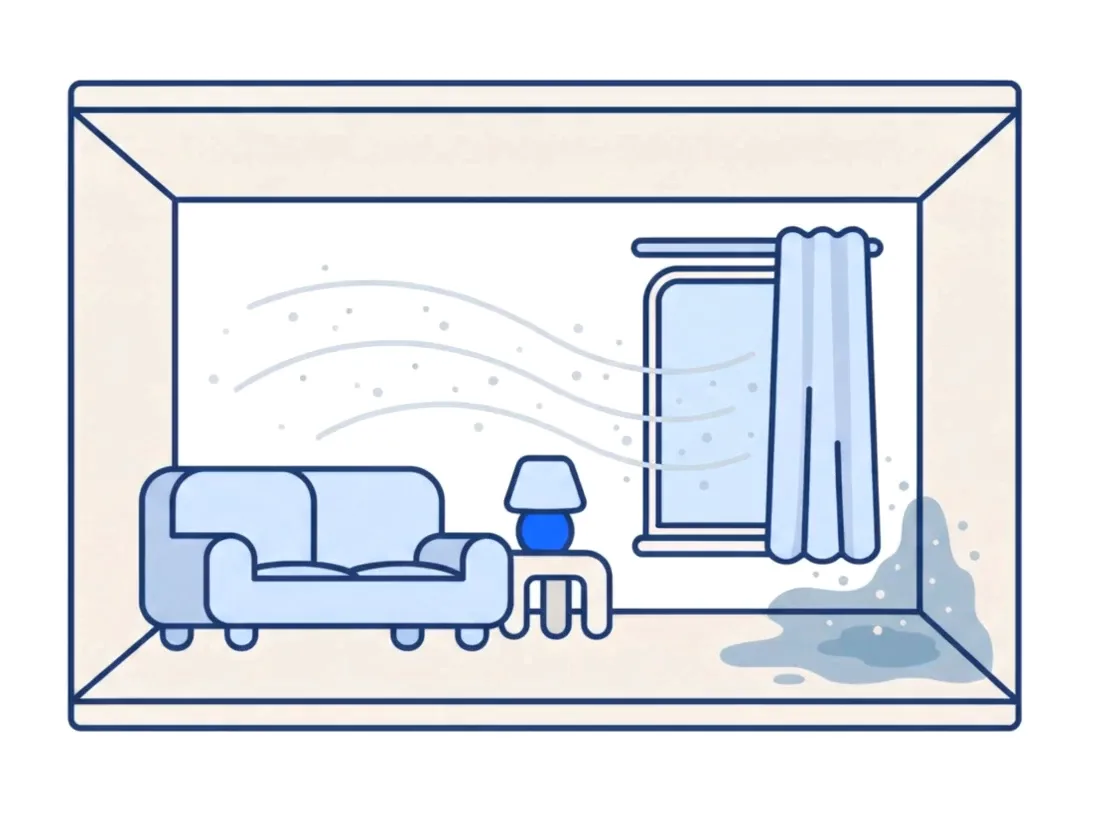
Up to 30% of new and remodeled buildings may draw excessive complaints about indoor air quality. The causes are almost never visible: mold spores in the air and in the air conditioning, volatile organic compounds (VOCs) from finishes and furniture, and ventilation that does not keep up with the number of people in the room. A laboratory test measures all of them and tells you which ones are present in yours.
Estimate of a World Health Organization (WHO) committee, as cited in the US Environmental Protection Agency (EPA) fact sheet on sick building syndrome.
Sick building syndrome is the name for health and comfort complaints linked to time spent in a particular building, without one illness anyone can point to. These are the symptoms people report most.
A headache that starts halfway through the working day, focus that is gone by the afternoon, tiredness that a good night does not fix.
Dry or watering eyes, a blocked nose, a burning throat and a dry cough, mostly in closed, air conditioned rooms.
A basement smell when the AC starts in the morning, in a wardrobe, under the sink or in one corner of a floor. A smell is a sign, even with no stain.
Attacks, a runny nose or itching that appear at the office or at home, and not on holiday, not outdoors and not at a relative's place.
The clue that matters: it eases when you leave.
Most people with sick building syndrome feel relief soon after they leave the building. When several people in the same space complain of the same thing, and it fades over the weekend, the building is the first suspect.
We test buildings, not people. Symptoms that persist should be seen by a doctor, and our report gives the doctor data on the environment you spend your days in.
A physical repair deals with what can be seen: a leaking pipe, a wet wall, a stain on the ceiling. Mold spores, spore fragments and the compounds some molds produce (mycotoxins) are too small to see, and they travel in the air. A central air system takes them from one wet spot and delivers them to every room it serves. Drying the wall does not tell you whether what grew there is still in the air or in the ducts.
Visual check and repair
CapsuLabs laboratory test
A known volume of air is drawn through a spore trap in every suspect space, and outdoors for comparison. That shows whether the air inside differs from the air coming in.
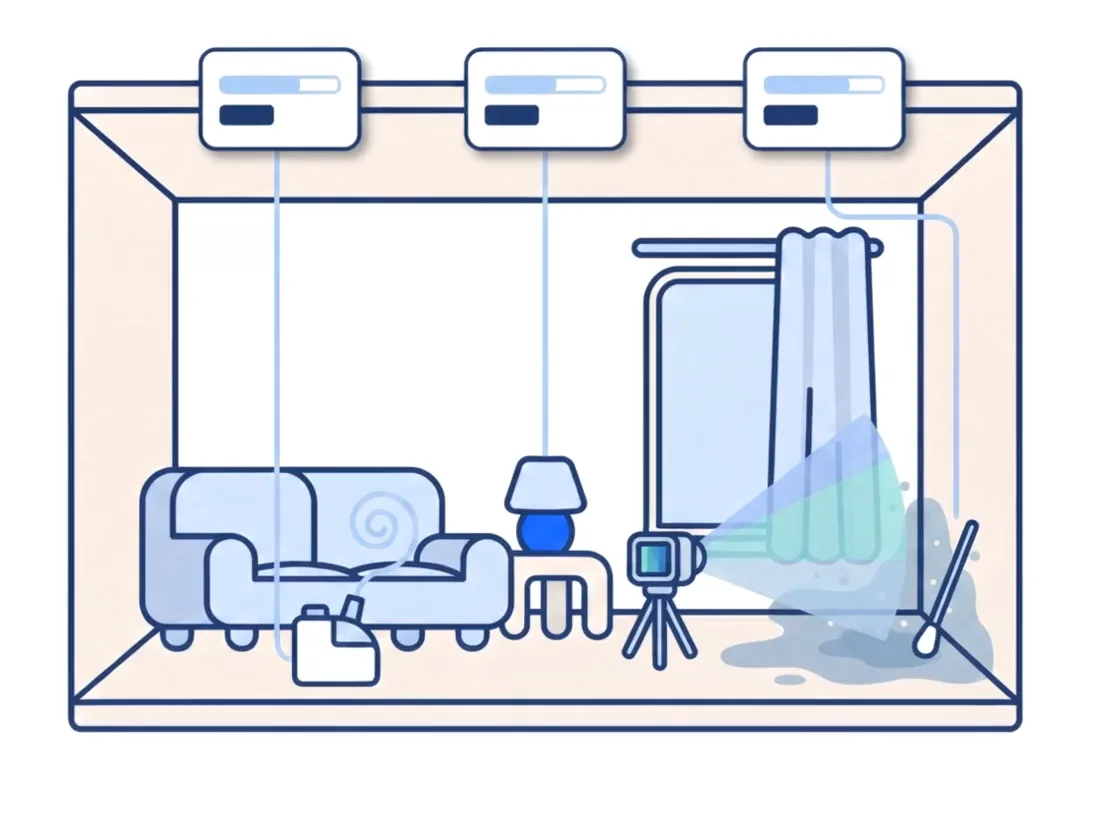
About this methodA thermal camera and moisture meters find damp behind walls, above acoustic ceilings and around AC units, in places the eye cannot reach.
About this methodSamples from drain pans, vents and suspect surfaces go to an accredited partner laboratory for species identification, to establish the source.
About this methodAn ERMI test of settled dust identifies the DNA of 36 mold species and gives an index that reflects exposure over time, not only the moment of sampling.
About this methodWhen there is reason to suspect long exposure, a mycotoxin panel tests for the compounds mold produces, not only for the mold itself.
About this methodCarbon dioxide (a measure of ventilation), volatile organic compounds, PM2.5, temperature and humidity, room by room.
About this methodWhen there are health complaints, everyone wants an answer they can trust: staff, management, the managing agent, residents and family.
CapsuLabs is an independent laboratory with no stake in the result. That is why insurers, lawyers, managing agents and employers use our reports as the starting point every party accepts.
Samples are analysed by accredited partner laboratories, with a chain of custody from the site to the bench. The report has a sampling map, results against outdoors, findings by responsibility and clear recommendations, documented so it can be used in a claim or a dispute.
Calibrated sampling pumps, a thermal camera, moisture meters, qPCR DNA analysis and air quality sensors. Each method answers a different question, and the sampling plan is built for your property.
Staff who complain of headaches, sick days that keep coming back, a floor where everyone has a cold. Measuring by air zone gives you a number to show staff instead of a promise.
Office testingB2B · PropertyResidential complexes and office buildings with central air, shared shafts and complaints that keep returning. Findings by responsibility, and continuous monitoring floor by floor if you need it.
Continuous monitoringB2C · HomesHigh-end apartments and villas after a renovation, with ducted air conditioning and windows that stay shut. One test that explains why the home does not feel right.
Air quality testingIt is the name for a situation in which people in a particular building have symptoms such as headaches, fatigue, eye, nose and throat irritation, a dry cough and difficulty concentrating, without a defined illness that explains them, and the symptoms ease soon after they leave the building. The usual causes are inadequate ventilation, chemicals from indoor sources (such as VOCs from adhesives, carpets, furniture and cleaning products), pollution drawn in from outside, and biological contaminants such as mold and bacteria.
With sick building syndrome there is no defined diagnosis, and the symptoms fade when people leave the building. Building related illness (BRI) is a condition that can be diagnosed and traced to a specific source in the building, and its symptoms do not always clear on leaving. In both cases testing the environment helps find the source.
A laboratory test does not diagnose people, it diagnoses the building. We measure what is in the air, on surfaces and in the air system, and compare it with the air outside. The medical diagnosis is the doctor's, and the report gives the doctor environmental data instead of a guess.
No. Sometimes it is ventilation that does not keep up with the number of people in the space (high carbon dioxide), sometimes VOCs from renovation materials and new furniture, and sometimes mold in the AC system or above the ceiling. That is why the test measures both air quality and mold, not only one of them.
The visit takes from one hour to a few hours, depending on the size of the property and the number of air zones. Lab results and the full report usually arrive within 10 to 14 business days.
The price depends on the size of the property, the number of samples and the methods chosen. After a short call about the property and the complaints, we send you a written quote with the sampling plan.
Leave your details and an expert will call you back, understand the complaints and the property, and build a sampling plan that answers the right question.
Or call directly:
051-506-5155Cookies on this site
We store only what the site needs to work: keeping you signed in, remembering your language, and checking you're not a bot. We also run Google's advertising tag on every page, to tell which ads bring people here. Until you allow it, that tag stores nothing on your device and sends Google only a basic, cookie-free signal. Allowing all lets it use cookies too. Cookie Policy · Privacy Policy